

Nitya Sahni
RP · Clinician · Ages 10+
Anxiety, neurodivergence, family-of-origin work, teens. From $160.
Read more Skip to main content
 Meeting kids in their own language.
Therapy for children and teens (ages 10+) — supporting them in understanding emotions and navigating challenges, with age-appropriate parent involvement.
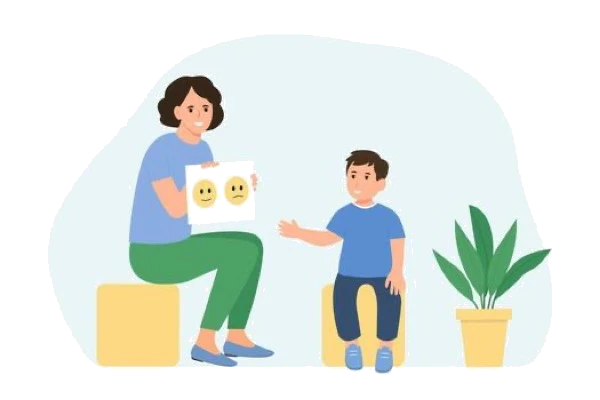
Therapy in a kid's own language.
Kids don't always have the words. So we work in the languages they do have.
Children's therapy is a developmentally tuned form of psychotherapy that helps kids and teens make sense of what's hard — emotions, behaviours, relationships, transitions. Younger children communicate through expression and behaviour; teens through conversation. The therapist follows what the child brings.
The work fits the kid. Pacing, modality, and the role parents play all flex with the child's age, comfort, and what they're working on.
What brings kids in.
You don't need a diagnosis. If something below sounds like your child, that's reason enough to talk.
Evidence-based tools, age-adapted.
Children's work draws on well-researched approaches selected based on the child's age, comfort, and what's bringing them in. Here's what shows up most often.
CBT-K
Age-adapted: helping a child notice the worry, name it, and try a different move. Concrete tools they can practice.
Art
Drawing, painting, building — when words aren't quite there yet. Process matters more than the result.
Mindfulness
Learning what the body is doing when feelings get big — and gentle practices for settling back down.
Narrative
Externalizing the hard stuff into a story they can hold from the outside. Often the easiest way in.
Same work, two ways in.
In person at our Etobicoke clinic, or by secure video anywhere in Ontario — Toronto, Mississauga, Brampton, and the wider GTA. Older kids and teens often do well online; younger kids usually benefit from in-person materials.
Sessions are 50 minutes either way, on a PHIPA-compliant video platform when online. The structure of parent involvement is set at intake and adjusts with age.
The shape of the first few weeks.
The early sessions look different for kids than for adults. Parents come first; the child meets the therapist on their own terms.
Week 0 — Parent intake
Parent and therapist talk through the history, the worries, the goals. We figure out the right approach for your child.
Week 1 — Meet your child
Your child gets to meet the therapist on their own terms. Light conversation or art depending on age. No pressure.
Weeks 2+ — The work
Weekly is typical. Sessions are 50 minutes; the structure of parent involvement is set at intake.
Nitya, Japnam, and Lissa work with kids and teens.
See the full teamNitya, Japnam, and Lissa all work with ages 10+ and bring developmentally tuned, family-systems training.
RP · Clinician · Ages 10+
Anxiety, neurodivergence, family-of-origin work, teens. From $160.
Read more
MSW, RSW · Clinician · Ages 10+
Trauma, anxiety, depression, life transitions. Online only. From $160.
Read more
RP(Q) · Clinician · Ages 10+
Family stress, teens, emotion regulation, self-esteem. Online only. From $160.
Read moreWhat it costs — and what's covered.
Sessions are 50 minutes. All fees include HST. We don't direct-bill, but provide detailed receipts after every session.
Standard
$160
Per 50-minute session. Parent intake and check-ins included.
Free
20 min
Parents only on the first call. No paperwork, no commitment.
Short answer: no. Psychotherapy provided by Registered Psychotherapists (RP) and Registered Social Workers (RSW) isn't covered by OHIP. It is, however, covered by most extended health benefit plans — look for "psychotherapist," "registered social worker," or "mental health" coverage in your benefits booklet.
Most workplace and student plans cover RSW and RP services for dependents. Per-session limits and annual maximums vary by plan. We provide detailed receipts you can submit for reimbursement directly — same-day, no portal. We don't currently direct-bill insurers.
The reduced-rate program is for individual therapy only — children's therapy is billed at the standard $160 rate. If cost is a real barrier, mention it on the consult and we'll talk through options.
Children ages 10+ and teens. Younger than that, we can refer you to a colleague who specializes in early childhood.
Older kids and teens: yes, often well. Younger children typically do better in person — they need physical materials (toys, art supplies) to do the work fully.
Honestly and low-stakes. Something like "we're going to meet someone whose job is to help kids work through hard feelings — like a feelings coach." Avoid framing it as something being wrong with them.
Younger kids: usually a parent check-in at the beginning or end of a session. Teens: less direct involvement, more privacy for them. We agree on the structure at intake.
Standard 50 minutes.
Many extended health plans cover RSW and RP services for child work. We don't direct-bill; we provide detailed receipts for reimbursement.
Common, and often the most useful information. The first sessions are designed to be low-stakes — your child sets the pace of how much they engage. Most kids settle in within 2–3 sessions.
Ready when you are
Parents only on the first call — no kid in the room yet. A short conversation about what's been happening, what you've tried, and whether we're a fit for your child.