 Skip to main content
Self-Esteem Therapy in Etobicoke & Online: Signs, Causes & How It Helps
The voice nobody else can hear.
Self-esteem is less about confidence and more about the baseline relationship you have with yourself. This page covers what self-esteem is, the signs of low self-esteem, where it comes from, and how therapy actually rebuilds it. In person in Etobicoke or virtually across Ontario.
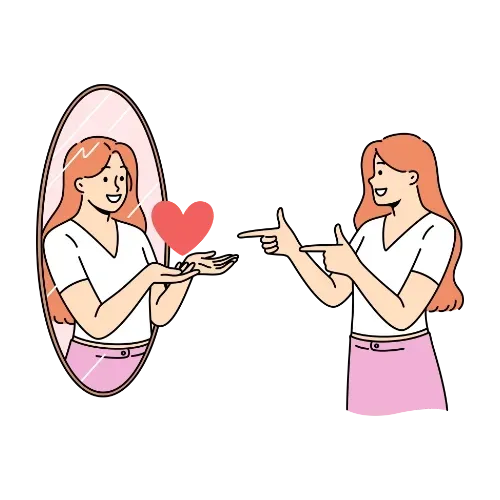
What is self-esteem? And how is it different from confidence?
Self-esteem, in plain language.
Self-esteem is less about confidence and more about the baseline relationship you have with yourself — how you talk to yourself when nobody's listening, how much room you give yourself to be flawed, and whether your worth feels conditional on performance.
Low self-esteem rarely looks like the cliché. People with low self-esteem are often high-functioning, well-liked, and visibly successful. The struggle lives in the gap between how the world sees them and how they see themselves — and in how much energy it takes to bridge that gap every day.
Confidence isn't built by repeating affirmations. It's built by understanding where the harshness came from, learning to hold your own complexity with more kindness, and slowly letting your self-talk catch up to who you actually are.
Low self-esteem signs: how it shows up in thinking, behaviour & relationships
How low self-esteem shows up.
Low self-esteem and confidence struggles show up in patterns more often than in moments. Some of the more common signs:
- Persistent self-criticism An inner voice that's quicker to find fault than to acknowledge effort, and that you wouldn't tolerate from anyone else.
- Difficulty accepting compliments Deflecting, minimizing, or feeling deeply uncomfortable when someone speaks well of you.
- Comparison spirals Measuring your worth against others — career, looks, relationships, social media — and consistently coming up short in your own estimation.
- Perfectionism Feeling you have to earn the right to take up space, rest, or ask for help. Treating mistakes as identity statements.
- People-pleasing Saying yes when you mean no. Tracking everyone else's mood and emotional state at the cost of your own.
- Difficulty making decisions Second-guessing, deferring to others, or freezing when something asks for your preference.
- Imposter feelings Sense that you've gotten away with something, that you'll be found out, or that your achievements don't reflect real ability.
- Avoiding visibility Hesitation to apply, speak up, lead, share work, or be seen — even in low-stakes contexts.
Self-esteem vs. self-confidence, self-worth & imposter syndrome
Four words people use interchangeably.
They get treated as the same thing, but they sit at different depths — and the distinction matters, because you can prop up one while the layer underneath stays untouched. That's why situational confidence hacks so often fail to stick.
- Self-esteem Your baseline view of your own worth — relatively stable, not tied to a single event. It's the background hum you carry into every room before anyone's said a word.
- Self-confidence Situation-specific belief that you can do a particular thing. You can be genuinely confident presenting at work and shaky the moment you leave the meeting. Confidence is real, but narrow.
- Self-worth The deepest layer — the conviction that you matter regardless of achievement, usefulness, or how well you're performing. When self-worth is conditional, no amount of success quite settles it.
- Imposter syndrome Despite clear evidence of competence, the persistent sense that you've fooled everyone and will eventually be found out. It attaches specifically to achievement — common in high-functioning professionals and first-generation success stories.
- Self-image The story you tell about who you are — traits, roles, appearance. It can be accurate and still sit on top of low self-worth. Fixing the description doesn't fix the feeling.
What causes low self-esteem? Where the inner critic comes from
Where it comes from.
Self-esteem patterns are usually inherited, not chosen. Knowing the source isn't about blame — it's about being able to recognize the pattern and choose differently going forward.
- Critical or conditional parenting Love, approval, or attention that depended on performance, behaviour, or appearance. Children adapt by becoming high-achievers — but the internal sense of "not enough" carries forward.
- Comparison and sibling dynamics Being measured against a sibling, cousin, or peer — explicitly or by implication. Often hidden in cultural framings of who's "the smart one" or "the responsible one."
- Cultural & family-of-origin pressures Achievement-focused cultures, immigrant family expectations, and the specific weight of being the first generation to "make it." The pressure to keep up or pay back can fuse worth with output.
- Bullying or peer rejection Especially during formative years. Even brief experiences can leave durable beliefs about being unwanted, unattractive, or fundamentally different.
- Difficult adult relationships Critical partners, hostile workplaces, repeated romantic rejection, or relationships where you were consistently devalued. These don't usually create low self-esteem from scratch — but they can amplify and entrench what was already there.
- Major life setbacks Job loss, divorce, illness, financial difficulty — events that pull the rug out from under the achievements people had been using to bolster a fragile sense of self.
How therapy builds self-esteem (CBT, self-compassion, IFS)
Why work with a therapist.
Self-esteem therapy isn't a confidence boot camp. It's a careful look at where the inner voice came from and a structured way to begin changing the relationship. A few of the things therapy can offer:
- 01
Understanding where the harshness came from
Self-esteem patterns are usually inherited from families, cultures, or formative relationships. Naming the source isn't blame — it's the start of being able to choose differently.
- 02
A relationship that models a different default
For many clients, therapy is the first sustained experience of being witnessed without judgement. That experience itself slowly retrains the internal narrator.
- 03
Evidence-based skill building (CBT, self-compassion, IFS)
Approaches like CBT (for the thinking patterns), self-compassion training (for the inner voice), and IFS / parts work (for the self-critical part) all have research support. We blend based on fit.
- 04
Practice in being a little more direct
Therapy is a low-stakes place to practice naming what you want, saying no, accepting help, and asking for what you need — small reps that compound outside the room.
- 05
Cultural fluency, not cultural translation
Our team brings deep familiarity with achievement pressure, intergenerational expectations, and the specific shapes self-esteem struggles take in South Asian and multicultural family systems.
Ready to work on this with a therapist?
Individual Therapy for self-esteem.
Therapy for self-esteem is delivered through our individual therapy service — in person at our Etobicoke clinic or by secure video anywhere in Ontario.
How to build self-esteem & confidence
What actually moves the needle.
There's no shortcut, and — as we said up top — no amount of repeating affirmations rewrites a self-critical baseline. What does shift things is slower and less glamorous: changing your relationship to the inner voice rather than trying to shout over it. These are practices you can start on your own; they also form the spine of the individual therapy we do around self-esteem.
- Trace the inner critic to its source The harsh voice was learned somewhere — a parent, a teacher, a culture, an old relationship. Naming whose voice it originally was makes it easier to stop treating it as simple fact.
- Treat self-compassion as a skill, not a feeling Self-compassion isn't waiting to feel warmly toward yourself. It's a practised response — speaking to yourself the way you'd speak to someone you respect who was struggling. It gets easier with reps, like anything else.
- Run small behavioural experiments Say no to one thing. Accept help once without deflecting. Let your work be seen before it's perfect. Small, deliberate reps that test the belief "if I take up space, something bad happens" — and gather evidence against it.
- Separate your worth from your output Achievement-based worth means the feeling resets to zero after every win. Notice when you're using productivity to earn the right to rest, and practise resting anyway.
- Catch the comparison the moment it starts Comparison spirals are automatic. You can't stop them appearing, but you can name them — "that's the comparison habit" — which is enough to loosen the grip and interrupt the negative thinking patterns underneath.
- Work the underlying layer, not just the situation Situational confidence hacks — power poses, prep, a good outfit — help on the day. But if self-worth is the issue, the underlying layer is where lasting change lives. That's the part therapy is built for.
Our blog goes deeper on the practical side of this in building self-esteem, a companion piece to the work of catching the inner critic.
When to seek therapy for self-esteem or confidence
Signs it's time to get support.
Low self-esteem rarely announces itself. It usually shows up as a quiet running cost on top of everything else you do. Consider therapy if any of the following has been true for a while:
- You spend a lot of energy keeping up appearances Functioning well externally while internally exhausted by the gap between how you're seen and how you feel.
- The inner voice has gotten louder over time The self-critical narrator that was always there now doesn't quiet down. Other people's compliments don't reach.
- You're saying yes to too much People-pleasing patterns are eating evenings, weekends, and emotional bandwidth. The cost shows up later, in resentment or burnout.
- You're avoiding visibility you'd otherwise want Holding back from applying, speaking up, leading, or sharing work — because the internal cost of being seen is too high.
- Past relationships keep replaying in current ones Same dynamics, different people. Often a sign that the inner sense of worth is shaping who you choose and how you stay.
- Achievements don't land the way they should Reaching the goals you set doesn't change the underlying feeling. That's the imposter loop, and it's a sign the work needs to be on the underlying layer, not on more achievement.
Self-esteem FAQ: common questions answered
What people ask first.
What is self-esteem, exactly?
Self-esteem is the baseline view you hold of your own worth — independent of any specific achievement or relationship. It's distinct from self-confidence (which is situation-specific) and self-image (how you describe yourself). Healthy self-esteem isn't about feeling great; it's about not having to fight against yourself just to function.
What's the difference between self-esteem and confidence?
Self-esteem is the underlying belief about your worth; confidence is what comes out of that in specific situations. You can build situational confidence (presentations, interviews) without addressing self-esteem, but it's harder to sustain. Therapy works on the underlying layer — confidence in specific domains tends to follow.
What causes low self-esteem?
Most low self-esteem traces back to formative experiences: critical parents or teachers, comparison to siblings, cultural messaging about success and worth, bullying, early relational instability, or being shaped by perfectionism. Adult experiences (a difficult job, a hurtful relationship, repeated rejection) can erode it further. Genetics and temperament play a smaller role.
What is imposter syndrome and how is it related?
Imposter syndrome is the persistent feeling that you've gotten away with something, that your achievements don't reflect real ability, and that you'll eventually be found out. It's closely tied to low self-esteem but specific to achievement and competence contexts. Common in high-functioning professionals, women in male-dominated fields, and first-generation success stories.
Is low self-esteem a psychological issue I should treat?
Low self-esteem isn't a clinical diagnosis on its own, but it's a meaningful psychological pattern and one of the most common reasons people start therapy. It frequently underlies anxiety, depression, and relationship difficulties — addressing it directly often shifts those too.
How does therapy actually build self-esteem?
Through three roughly overlapping streams: (1) understanding where the inner critic came from, (2) practicing self-compassion as a skill — not a feeling, and (3) experimenting with new behaviours (saying no, asking for things, taking up space) and integrating what you learn from those experiments.
What therapy approach works best for self-esteem?
CBT for thinking patterns, self-compassion-focused therapy for the inner voice, and IFS / parts work for the self-critical part have strong evidence. ACT (acceptance and commitment therapy) also helps with values clarification, which often gets buried under low self-esteem.
Will therapy make me arrogant?
Genuine self-esteem and arrogance are pretty much opposites. Arrogance is performative; healthy self-esteem is quiet. Most clients we see are far more concerned about being liked than about being too sure of themselves — therapy doesn't push the dial in the wrong direction.
Can self-esteem be rebuilt as an adult?
Yes. The patterns that shaped your self-esteem in childhood are deeply grooved but they're not permanent. Therapy provides the conditions — sustained witnessing, evidence-based skills, and structured practice — that allow the inner narrator to slowly shift. Most clients see meaningful change in 4–9 months of consistent work.
How long does self-esteem therapy take?
Most clients work with us for 4–9 months. Some patterns shift earlier; deeper ones (especially when tied to formative experiences) take longer. We re-evaluate every few months and there's no fixed minimum.
Can I do this online?
Yes. We offer PHIPA-compliant video sessions across Ontario. Self-esteem work translates well to virtual sessions — many clients find the slight remove makes it easier to be honest about the inner voice.
Is self-esteem therapy covered by OHIP?
No. Psychotherapy provided by Registered Psychotherapists (RP) and Registered Social Workers (RSW) isn't covered by OHIP. It is, however, covered by most extended health benefit plans — look for psychotherapist, registered social worker, or mental health coverage in your benefits booklet.
Self-esteem & confidence resources
External support to lean on.
-
Self-Compassion — Dr. Kristin Neff
Researcher behind much of the modern self-compassion field. Free guided practices and self-assessment tools.
-
CAMH — Mental health resource library
Canada's leading mental health teaching hospital. Plain-language, clinically reviewed material across topics.
-
Wellness Together Canada
Free, government-funded mental health support — 24/7 phone counselling and online tools.
-
ConnexOntario
Free, confidential 24/7 information line for mental health and addictions support across Ontario. Call 1-866-531-2600.
Related areas therapy helps with
Other things therapy helps with.
Ready when you are
Take the first step toward feeling like yourself again.
Book a free 15-minute consultation. No paperwork, no commitment — just a conversation about what you're going through and whether we're a fit.