

Nitya Sahni
RP · Clinician
Family dynamics, parenting, neurodivergence, complex relationships. From $190.
Read more Skip to main content
 For the patterns that started before any of you.
Therapy for parents and children together, blended families, and intergenerational households — a structured space to surface the dynamics and start changing them.
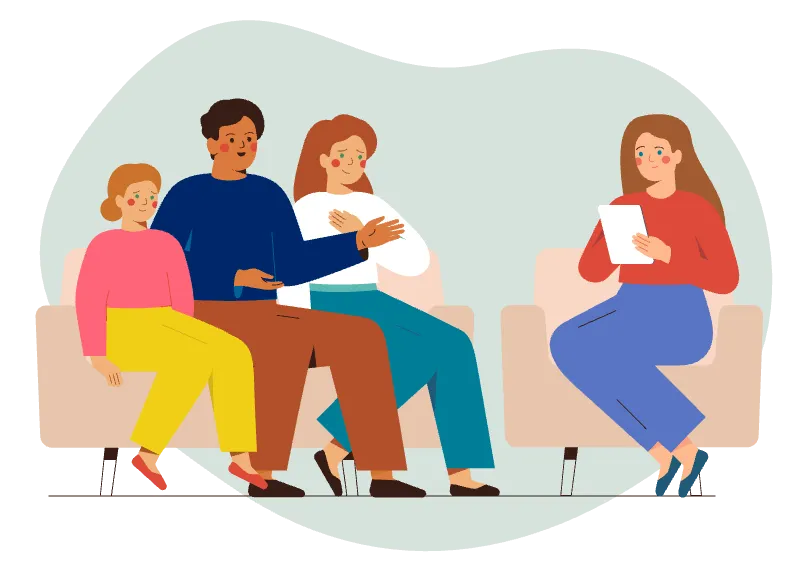
Therapy that holds the whole system.
For the patterns that affect all of you.
Family therapy is a structured space where members of a family work together with a registered clinician to understand the dynamics that have been quietly shaping daily life. Some patterns are obvious — the same argument, the same withdrawal. Others are inherited from generations back and only show up under stress.
The work fits the family. Sometimes everyone is in the room; sometimes parents alone; sometimes parents and one child. We figure out who needs to be present based on what's getting worked on.
What brings families in.
You don't need everyone to agree it's a problem. If one person sees it, that's reason enough to start.
Evidence-based tools, fit for a system.
Family work draws on well-researched frameworks selected based on what's playing out in the room. Here's what shows up most often.
Structural
Mapping the family system: who has the loudest voice, who keeps the peace, who carries the worry.
EFT-F
Reaching the underlying emotion before the pattern repeats — so the cycle has somewhere different to go.
CBT
Concrete tools the family can use between sessions — for triggers, communication, conflict de-escalation.
Narrative
Re-authoring the family story so it's not just one person's version of events that wins.
Cultural
When the rules nobody wrote down are the loudest ones — naming them, working with them, sometimes rewriting them.
Same work, two ways in.
In person at our Etobicoke clinic, or by secure video anywhere in Ontario — Toronto, Mississauga, Brampton, and the wider GTA. Family members can join from the same room or from different locations.
Sessions are 50–90 minutes depending on how many people are in the room. Online sessions run on a PHIPA-compliant video platform. Most families mix the two depending on the week.
The shape of the first few weeks.
Family therapy isn't linear, but the early pacing is predictable. Who needs to be in the room shifts as we go.
Week 0 — Free consult
Usually a parent or both parents. Tell us what's been going on. Ask questions. See if we're a fit.
Week 1 — Intake
Usually with whoever can come. We get the lay of the land — the dynamics, the goals, the pacing.
Weeks 2+ — The work
Pacing varies. Some families come weekly for a stretch, then space out. We may meet with subsets between joint sessions.
Nitya, Japnam, and Lissa offer family therapy.
See the full teamAll three bring deep family-systems training, cultural fluency, and steady presence in difficult conversations.
RP · Clinician
Family dynamics, parenting, neurodivergence, complex relationships. From $190.
Read more
MSW, RSW · Clinician
Trauma, family transitions, teens and parents. Online only. From $190.
Read more
RP(Q) · Clinician
Family stress, parenting, relationship dynamics. Online only. From $190.
Read moreWhat it costs — and what's covered.
Sessions run 50–90 minutes depending on who's in the room. All fees include HST. We don't direct-bill, but provide detailed receipts after every session.
Standard
$190
Per 50-minute session. Longer sessions (up to 90 min) prorated.
Free
20 min
Usually with whoever's reaching out. No paperwork, no commitment.
Short answer: no. Psychotherapy provided by Registered Psychotherapists (RP) and Registered Social Workers (RSW) isn't covered by OHIP. It is, however, covered by most extended health benefit plans — look for "psychotherapist," "registered social worker," or "mental health" coverage in your benefits booklet.
Most workplace and student plans cover RSW and RP services. Per-session limits and annual maximums vary by plan. We provide detailed receipts you can submit for reimbursement directly — same-day, no portal. We don't currently direct-bill insurers.
The reduced-rate program is for individual therapy only — family therapy is billed at the standard $190 rate. If cost is a real barrier, mention it on the consult and we'll talk through options.
It depends. Sometimes the whole family. Sometimes parents alone. Sometimes parents and one child. We figure out who needs to be in the room based on what's getting worked on.
Sessions run 50–90 minutes depending on how many people are in the room and what we're working on. Longer sessions for full-family meetings; shorter for subset work.
Therapy can still work without them, often. Family-of-origin patterns can be worked on even with one or two members in the room. We talk through what's possible at the consult.
Family therapy treats the system, not just the person. Individual therapy might feel like solving you; family therapy is solving the dynamic between you. Both can run alongside each other.
No. The therapist's job is to hold the whole system — including the points of view that don't have a voice yet. No one gets ganged up on.
Many extended health plans cover RSW and RP services for family work. Coverage varies by plan. We don't direct-bill; we provide detailed receipts for reimbursement.
The consult is where we figure that out. If we're not right for what your family needs, we'll say so honestly and point you toward someone who is.
Ready when you are
No paperwork, no commitment. A short conversation about what's been happening at home and whether we're a fit. Whoever's reaching out can call — others can come in later as we go.